Personalizing #3
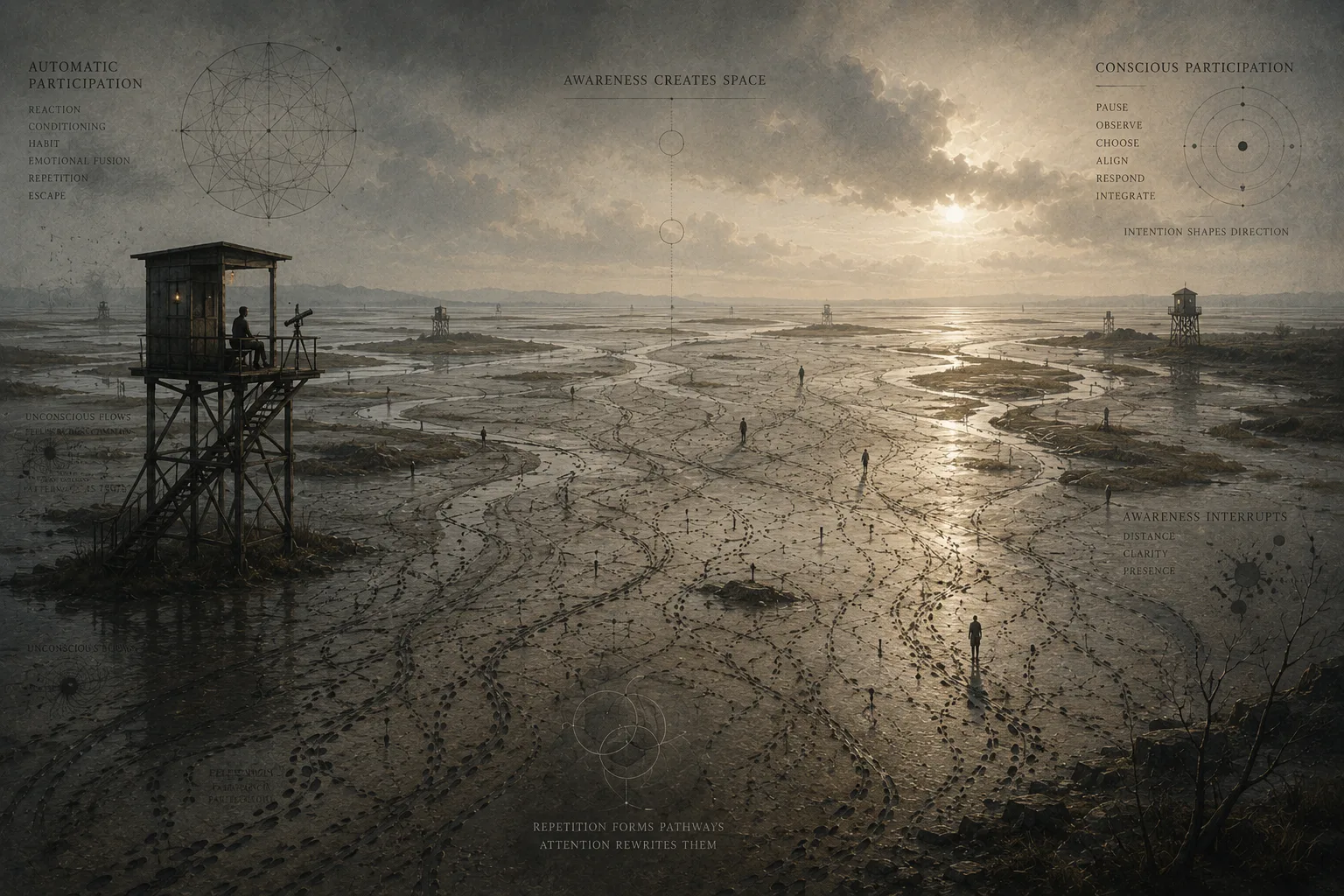
Personalizing describes the shift from observing what is actually happening to filtering situations through a self-centered story, where feelings of "this is about me" override reality and create unnecessary suffering until awareness separates external facts from the meanings assigned to them.
Personalizing occurs when I begin interpreting situations primarily through my own perspective rather than reality.
In that sense, personalizing quietly shifts awareness away from observation and toward self-centered interpretation. I stop asking, “What is actually happening here?” and start asking, often unconsciously, “What does this say about me? What does this mean for me?” The center of gravity moves from the situation itself to my own emotional story about it.
Other people’s actions become about me.
Other people’s moods become about me.
Circumstances become about me.
Feedback becomes about me.
Once that shift happens, almost anything can be pulled into a personal frame. A delayed text becomes proof that someone is upset with me. A neutral comment starts to feel like criticism. A friend’s bad mood turns into evidence that I did something wrong. Even random inconveniences can start to feel targeted, as if life is somehow singling me out.
Because emotional interpretation often feels convincing, it becomes easy to mistake personal meaning for objective reality. The feeling of “this is about me” arrives fast and with a lot of certainty, while the slower work of checking what’s actually true often doesn’t happen unless I deliberately pause and question it.
A lot of suffering grows from this process—not because reality itself changed, but because interpretation quietly transformed neutral or ambiguous situations into emotionally charged personal experiences. The external facts might be simple or even minor, but once they pass through a personalized filter, they can turn into shame, resentment, anxiety, or self-attack. The pain comes less from what happened and more from what I decided it meant about me.
In the past, I sometimes assumed my emotional reactions accurately reflected what situations meant, without fully recognizing how much personalizing was influencing perception underneath. If I felt hurt, I assumed someone must have intended to hurt me. If I felt rejected, I assumed I was being rejected. I didn’t see that my own history, insecurity, and fear were shaping the story I was telling myself about what was happening.
In recovery, I’m learning that awareness requires separating reality from interpretation. There is what happened, and then there is what I made it mean. Those are not the same thing, even though they can feel fused in the moment. Slowing down enough to notice that difference is part of staying in touch with reality rather tha,rather than livingmy own lens getting lost in my own narrative.
Not everything is about me.
Not every reaction is directed at me.
Not every event is connected to me.
Letting those sentences actually land creates space. It doesn’t mean I dismiss my feelings, but it does mean I hold them as information rather than as proof. It allows for the possibility that someone else is having their own experience that has nothing to do with me, or that a situation is simply neutral and doesn’t carry the personal meaning I’m assigning to it.
This connects directly to “purpose,” because personalizing narrows awareness while purpose expands it toward something larger than myself. When I’m caught in personalizing, my attention collapses inward and I lose sight of broader participation, contribution, and alignment. When I’m oriented toward purpose, I’m more able to see situations in terms of what’s needed, what’s true, and how I can show up, rather than in terms of what everything says about me.
It also connects to “do your thing and everything will follow,” because personalizing often distracts me from my own process by pulling attention toward emotional interpretation instead of participation. If I’m busy analyzing what everyone’s behavior means about me, I’m not actually doing my thing. I’m not engaging with my responsibilities, my structure, or my next right action. I’m absorbed in decoding perceived signals instead of participating in my own life.
So for me, personalizing means allowing self-centered interpretation to become stronger than objective observation. It’s when my internal story overrides what’s actually in front of me, and my sense of self becomes the main lens through which everything is filtered.
Today, I’m trying to observe situations more honestly instead of automatically filtering them through myself. That means pausing before I decide something is about me, checking what I actually know versus what I’m assuming, and remembering that other people’s behavior often reflects their own internal state, not my worth or failure. It’s a practice of returning to observation, again and again, instead of letting personalizing quietly run the show in the background.