Sunday, May 10, 2026
Structure Creates Freedom
A reflection on how structure, accountability, repetition, and grounded participation create the conditions for psychological freedom.
One of the most counterintuitive realizations in my life has been discovering that structure creates freedom.
At first, this idea felt almost offensive to the emotionally reactive part of me. Structure seemed restrictive. Rules felt limiting. Accountability felt exposing. Repetition felt lifeless. Freedom appeared to exist somewhere outside obligation, routine, discipline, or containment. I associated freedom with emotional spontaneity, unrestricted movement, immediate self-expression, and escape from pressure.
But over time, especially through recovery and sustained reflection, I began noticing something unsettling: many of the behaviors that felt most immediately freeing were quietly making my life smaller.
Impulsivity can feel like freedom in the moment because it removes friction between feeling and action. Emotional urgency feels liberating because it promises immediate relief. Avoidance feels freeing because it temporarily reduces discomfort. Fantasy feels freeing because it suspends reality. Reassurance-seeking feels freeing because it temporarily quiets uncertainty.
But these forms of freedom are unstable because they depend on escape rather than grounded participation.
The paradox is that emotional impulsivity often produces long-term psychological imprisonment. A person becomes governed by fluctuating internal states they no longer know how to tolerate. The nervous system gradually loses the ability to remain present without immediate regulation through distraction, stimulation, emotional escalation, compulsive behavior, or avoidance.
This realization changed the way I understood discipline.
I used to think discipline primarily meant suppression: forcing oneself to comply with external demands regardless of emotional reality. But real structure is not simply rigid obedience. At its best, structure functions as a stabilizing relationship with reality. It creates continuity during periods when emotions, motivation, or identity become unstable.
Recovery made this impossible to ignore.
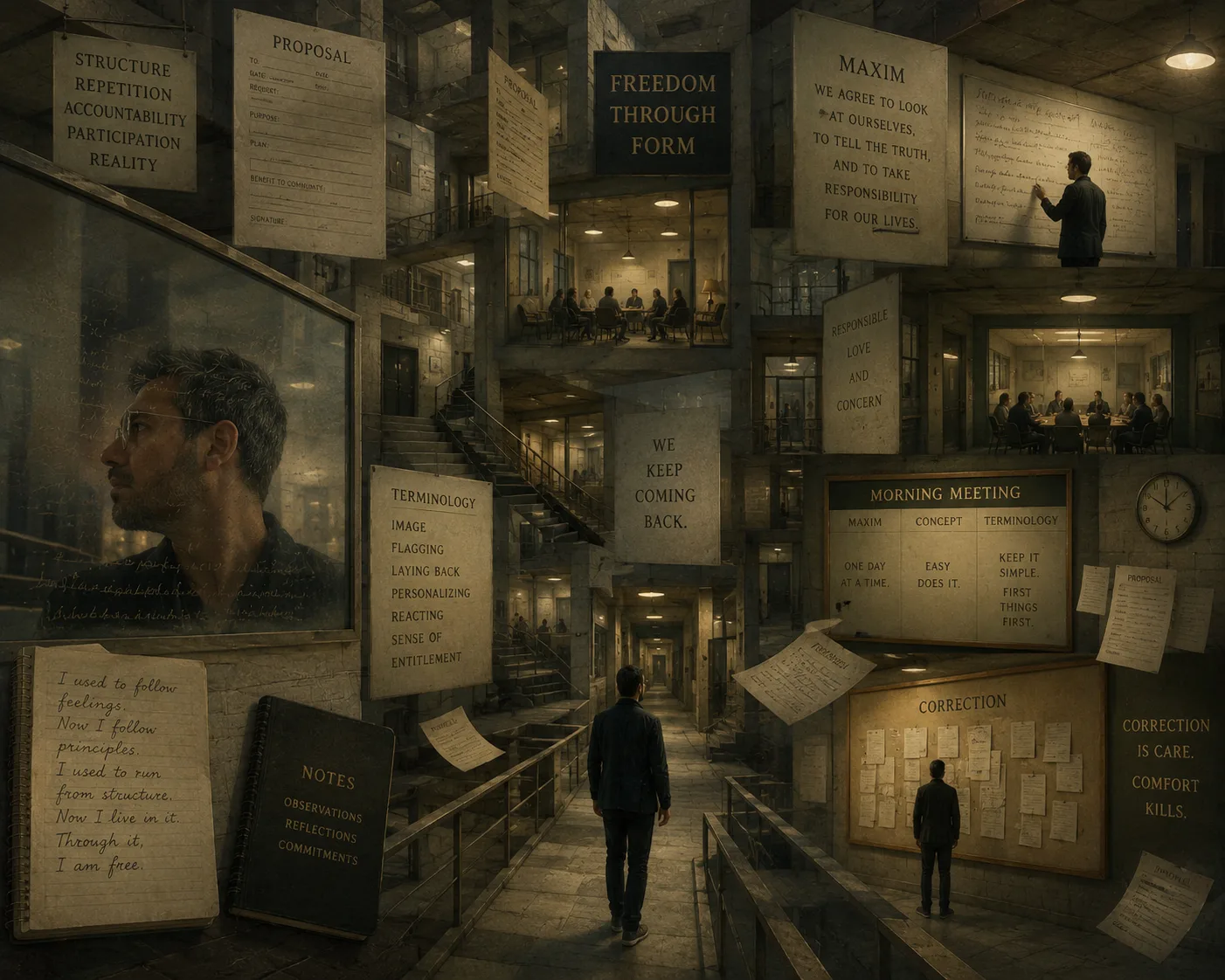
Meetings. Schedules. Morning structure. Accountability. Repeated participation. Behavioral expectations. Community feedback.
At first, these things can feel externally imposed, almost artificial. The emotionally reactive self resists them because they interrupt impulsive movement. They force pause where the nervous system wants immediate discharge. They slow reaction long enough for awareness to emerge.
But over time I began recognizing that structure was not reducing my freedom. It was increasing my capacity to remain functional, grounded, and behaviorally aligned even during emotional instability.
That distinction matters enormously.
Without structure, emotional states easily become behavioral commands. Anxiety demands action. Shame demands concealment. Longing demands reassurance. Fear demands escape. The self becomes increasingly governed by whichever emotional state is strongest in the moment.
Structure interrupts that automatic relationship between feeling and action.
It creates space.
Inside that space, a different form of freedom becomes possible: the freedom to choose participation instead of compulsion.
This is why recovery structure often functions psychologically as containment. Containment is not punishment. It is stabilization. It prevents emotional escalation from immediately becoming behavioral escalation. It protects the future self from the emotionally activated self.
I slowly realized that many forms of suffering are intensified by the absence of containment. Without structure, thoughts spiral more easily. Emotions escalate more rapidly. Impulses become harder to interrupt. Identity fragments more quickly. The nervous system becomes increasingly reactive because there is nothing stable enough to absorb emotional fluctuation.
Structure absorbs fluctuation.
Routine absorbs fluctuation. Accountability absorbs fluctuation. Repetition absorbs fluctuation. Grounded participation absorbs fluctuation.
This does not eliminate pain or uncertainty. It changes the relationship to them.
I also began recognizing that structure reduces the amount of psychological energy spent renegotiating reality constantly. Without stable forms, every moment becomes a fresh emotional referendum: Should I show up? Should I avoid this? Should I escape? Should I isolate? Should I react? Should I abandon the process?
The mind becomes exhausted trying to govern itself entirely through emotional immediacy.
Structure reduces this burden by creating continuity independent of mood.
This continuity becomes psychologically protective.
A person does not need to reinvent themselves every morning. They return to the practice. Return to the schedule. Return to the commitments. Return to participation. Return to reality.
That return matters deeply because identity is shaped through repetition far more than through isolated emotional moments.
This is one reason structure initially feels uncomfortable: it exposes how dependent the self may have become on emotional fluctuation. A nervous system organized around intensity often experiences steadiness as emptiness at first. Predictability can feel emotionally flat when the mind has become accustomed to stimulation, urgency, or chaos.
But over time, something subtle begins changing.
The nervous system gradually learns that stability is survivable. Discomfort becomes more tolerable. Pause becomes less threatening. Impulse loses some of its authority. Consistency becomes less emotionally foreign.
This is not emotional numbness. It is increased groundedness.
Groundedness allows the self to remain connected to reality without constantly fleeing discomfort through reaction or fantasy.
I think this is why accountability matters so much.
Accountability is often misunderstood as surveillance or punishment, but healthy accountability functions more like orientation. Other people help us see what emotional self-justification obscures. They reflect reality back to us when our interpretations become distorted. They interrupt the mind’s tendency to rationalize destabilizing behavior simply because it feels emotionally urgent.
This is uncomfortable because emotional life often seeks exemption. The self wants exceptions for fear, loneliness, anger, exhaustion, longing, insecurity, or shame. Structure repeatedly refuses to let temporary emotional states become total organizing principles.
That refusal is protective.
One of the deepest shifts recovery produced in me was the understanding that freedom is not the absence of limitation. Freedom is the increased capacity to remain aligned with reality, values, responsibility, and participation despite emotional fluctuation.
That capacity requires structure.
A musician develops freedom through practice. A writer develops freedom through discipline. A stable relationship develops through repeated participation. Emotional regulation develops through repeated grounding. Recovery develops through repeated alignment.
The same principle appears everywhere: form creates capacity.
This understanding also transformed the way I viewed repetition.
Repetition once seemed lifeless to me, almost mechanical. But repetition is how the nervous system learns. Repetition builds familiarity. Repetition creates trust. Repetition weakens chaos by strengthening continuity. Every repeated grounded action slowly teaches the self that stability is possible without emotional escape.
Most meaningful freedom emerges gradually through these repetitions.
The freedom to pause before reacting. The freedom to tolerate uncertainty. The freedom to remain honest without collapsing into shame. The freedom to participate without emotional performance. The freedom to remain present without immediate escape.
None of these freedoms are produced by impulsivity alone.
They are developed.
And development requires structure.
This is why I no longer see structure as the opposite of freedom.
I see structure as the condition that makes sustainable freedom possible.
Not freedom from reality, but freedom within reality.
Not freedom from discomfort, but freedom from compulsive escape.
Not freedom from responsibility, but freedom through increasing alignment between action, value, participation, and selfhood.
Structure creates enough stability for a person to remain present long enough to become someone different.
And eventually, what once felt restrictive begins to feel like support.
The structure does not imprison the self.
It teaches the self how to stand.